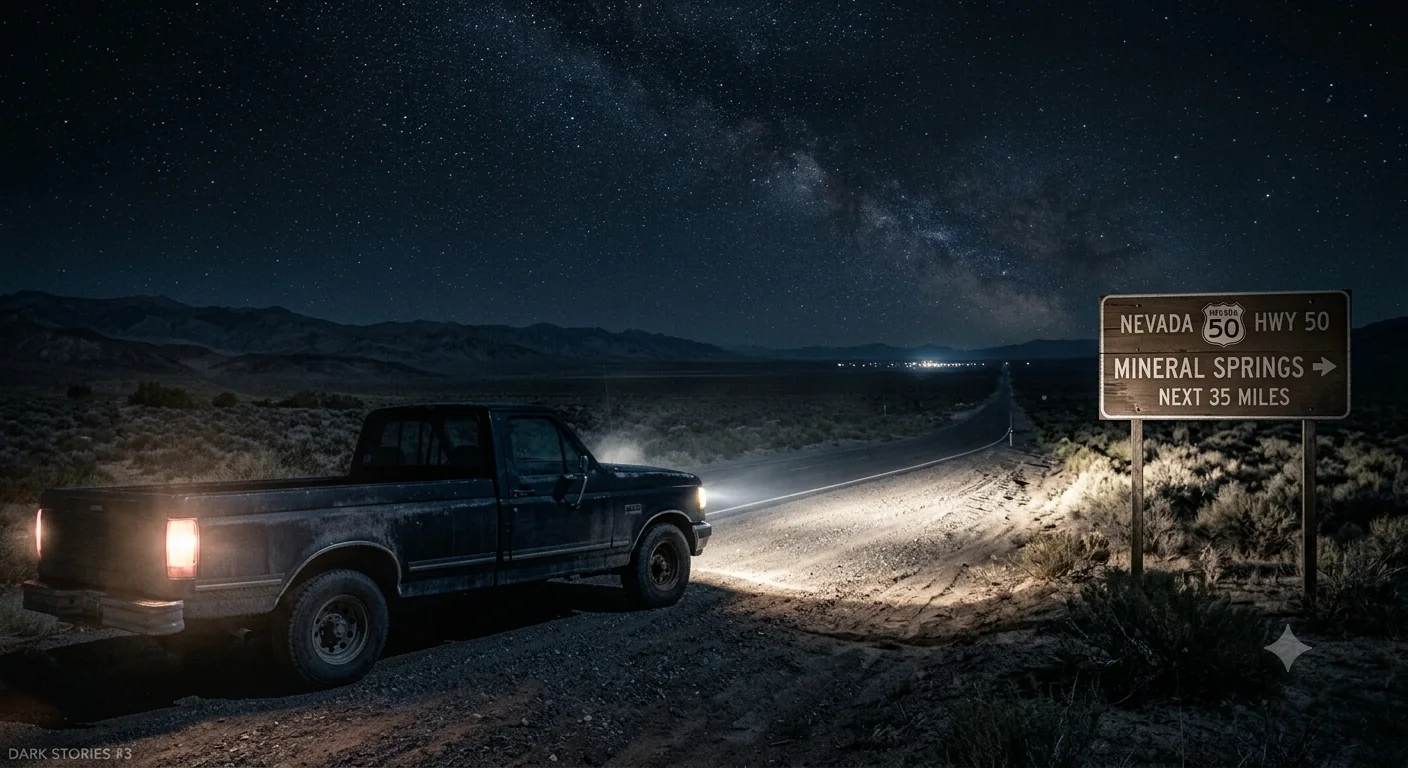
His name was Ray Sellers, and the last honest thing he ever owned was a 2003 Ford F-150 with a cracked windshield and a tape deck that only played the B-side of a Merle Haggard cassette he'd found under the seat. He was fifty-three years old. He had forty dollars in his wallet, a bad knee from a fall on a construction site in Laughlin, and a phone that still received texts from his daughter in Phoenix that he hadn't answered in eleven weeks.
The town was called Mineral Springs. It wasn't on any map he'd seen. The sign at the junction said the population was 214, but someone had crossed out the 4 with a marker and written 3 underneath, then crossed that out too and drawn a question mark. Ray didn't find this funny. He found it accurate.
There are places that exist not because someone built them with intention, but because a road went somewhere and people followed and then the road stopped and the people stayed.
The Dry Gulch Bar was the last building before the highway ended at a chain-link fence and a lot of sand and a sign that said RESTRICTED — DEPT. OF DEFENSE that nobody had believed since 1987. Ray went in because he was thirsty and because his knee hurt and because the alternative was sleeping in the truck again.
There were two people inside. The bartender was a woman named Connie who wore her grey hair in a braid and didn't ask questions. The other was a man in the corner whose name Ray never learned, who was playing the slot machine with the concentration of someone performing surgery.
I
The machine was a Dead or Alive 2. Ray knew it immediately. Not because he was a gambler — he hadn't considered himself one since Reno, since the thing in Reno that he didn't talk about — but because you don't forget a machine that takes three thousand dollars from you in four hours. You remember its face the way you remember the face of anyone who has hurt you. The five reels, the western icons, the sheriffs and the outlaws, the boots and the gold bars. The High Noon feature he'd never triggered. The 111,111x that existed somewhere in mathematics but not in his experience.
"You want a drink or you want to look at it," Connie said. It wasn't a question.
Ray ordered a beer and sat at the bar with his back to the machine. He managed this for approximately seven minutes.
The man in the corner didn't win anything. He didn't lose anything dramatic either. He fed the machine in small bills — fives, a few tens — with the rhythmic patience of someone watering a plant they know is already dead. He wasn't agitated. He wasn't hoping. He was simply there, in the way that an object that has been in a room long enough stops being noticed.
Ray finished his beer and ordered another and told himself he was leaving after this one.
II
What Ray understood about Dead or Alive 2, in the technical sense, was this: there were three versions of the game. Train Heist, Old Saloon, and High Noon. The volatility was extreme — higher than most machines he'd played, and he'd played most of them across most of Nevada and parts of Arizona. The RTP was 96.82%, which sounded generous until you understood that it meant nothing over any session a human being could actually endure. The High Noon feature, if you triggered it, gave you sticky wilds and retriggerable free spins. The 111,111x was theoretical. Possible. Documented. Somewhere, once, a screen had shown that number and someone had been sitting in front of it.
What Ray understood about Dead or Alive 2 in the other sense — the sense that mattered, that lived below the data — was harder to say. The machine felt like the desert. Flat and patient and indifferent. It didn't promise anything. Other machines had bonus symbols that blinked at you, that seemed to lean forward, that seemed almost to want you to win. Dead or Alive 2 sat there the way the desert sat there: it would be there long after you were gone, and it had no opinion about you either way.
He found this more frightening than the machines that flattered him.
The man in the corner eventually left without saying anything to anyone. He took his jacket from the back of the chair and folded it over his arm carefully, like a man who had learned to be careful about the small things because the large things were beyond him.
Ray moved to the machine at nine-fourteen PM. He put in a twenty.
III
He told himself he would stop at forty dollars. That was the limit. He had forty dollars and when it was gone he would sleep in the truck and drive to Kingman in the morning and call the foreman at the site who had said there might be work in July. This was the plan. It was a reasonable plan. It was the kind of plan a person makes when they still believe that plans mean anything in front of a machine like this.
The forty became sixty when Connie gave him change for a fifty she said he'd given her, though Ray was fairly certain he'd given her a twenty. He didn't argue. He was already watching the reels.
Dead or Alive 2 gave him nothing for the first forty minutes except the specific texture of its sounds — the dry click of the reels, the brief melody when a small win appeared and disappeared. There was a scatter symbol on reel three that came up twice in twelve spins and then not again for another thirty. He was not in the free spins feature. He was in the base game, which was where most of the money went, which was where most of the time went, which was where most of everything went.
Connie turned off the overhead light at eleven and left the bar lamp on. The desert outside was absolutely dark. There were no other cars in the lot, no sounds from the highway. Ray was the only thing moving in Mineral Springs, Nevada, and what he was moving was his right index finger against the spin button.
IV
At eleven forty-seven, it happened.
Three scatter symbols on reels one, three, and five. The screen changed colour. The dry western melody shifted into something older, slower, more ceremonial. High Noon. He was in the High Noon free spins.
Connie looked up from whatever she was reading.
Ray's heart was doing something complicated. He had been here before — not in this machine, not in this town, but in this moment. The moment before the thing that might change everything, which almost never changed anything, which sometimes made it worse. He knew this moment well enough to distrust it and not well enough to leave it.
The first free spin landed a wild on reel two. Sticky. It stayed. The second spin: another wild, reel four. The machine tracked them on screen — two gold sheriff stars that wouldn't move, that accumulated. The third spin: nothing. The fourth: a wild on reel one. Three sticky wilds across the reels, and the multiplier climbing in the way that multipliers climb — incrementally, mercilessly, in a way that your nervous system was not designed to absorb without consequence.
He thought about his daughter. He hadn't meant to. She appeared anyway — her name was Lily and she was twenty-six and she lived in Phoenix and she had stopped asking him things directly because direct questions got no answer, so she sent texts that were really questions dressed as statements. "Thinking about you. Hope you're eating." He hadn't answered. He didn't know what to say that was true and also kind.
The seventh spin retriggered. More free spins. The multiplier was at 12x. The wilds held.
Ray was not breathing normally. He was aware of this and could not correct it. The screen was showing him something he had never seen on this machine and he had played this machine, or versions of it, more times than he could count, and the number climbing in the corner of the screen — the accumulated win — had passed the point where it was still abstract and entered the territory where it meant specific things. It meant the truck payment. It meant Lily. It meant Kingman or not-Kingman. It meant the knee surgery he'd been putting off since the fall, since the thing in Reno, since the long sequence of decisions that had each seemed small and together had made him the man in the bar in Mineral Springs, Nevada at eleven forty-seven PM with four dollars outside this machine.
V
He won $1,840.
Not 111,111x. Not the theoretical maximum. Not the number that lived in the mathematics of the game and nowhere else he'd ever been. But $1,840 on a $0.30 spin, which was 6,133x, which was real, which was sitting on the screen in white numbers that Connie confirmed by walking over and standing next to him and saying "well" in a tone that communicated everything without committing to anything.
Ray cashed out. The machine printed a ticket. He sat holding it for a moment.
The question — the only question — was whether he would put it back.
This was always the question. He'd won in Reno too. Not as much, but enough. Enough to leave. Enough to call it a night and drive to the motel and sleep and wake up with the money still real. He hadn't done that in Reno. The machine in Reno had a bonus feature he hadn't triggered yet. He'd needed to see it. The seeing of it had cost him everything he'd won and three thousand more and the motel had cost him two more days and by the time he drove out of Reno he owed money he didn't have to a card he'd closed two years prior through a decision he couldn't fully reconstruct.
He stood up. He put the ticket in his shirt pocket. He buttoned the pocket.
"You got somewhere to be?" Connie asked.
"Phoenix," Ray said. It was the first time he'd said it out loud in eleven weeks and it didn't feel like a decision so much as something that had always been true, waiting for him to notice it.
He drove through the night. The desert was cold in the way deserts are always cold when the sun is gone, in the way that surprises people who imagine deserts as only one temperature. The B-side of the Merle Haggard cassette played until it ended and the tape deck clicked off and then there was just road and dark and the headlights finding the next hundred feet and nothing beyond them.
He stopped at an ATM in Kingman at three AM and deposited the ticket, which took until morning to clear. He sat in the truck in the parking lot until the bank opened. He withdrew $200 for the road. He transferred the rest to an account he hadn't touched in two years, in Lily's name.
He didn't text her. He didn't know what to say that was both true and kind, and he still didn't. But he thought there might be time to figure that out. He thought there might still be some of that left.
He drove the rest of the way to Phoenix in the morning light.
Five miles outside the city, the truck needed water.
He stopped and found some.
He kept going.