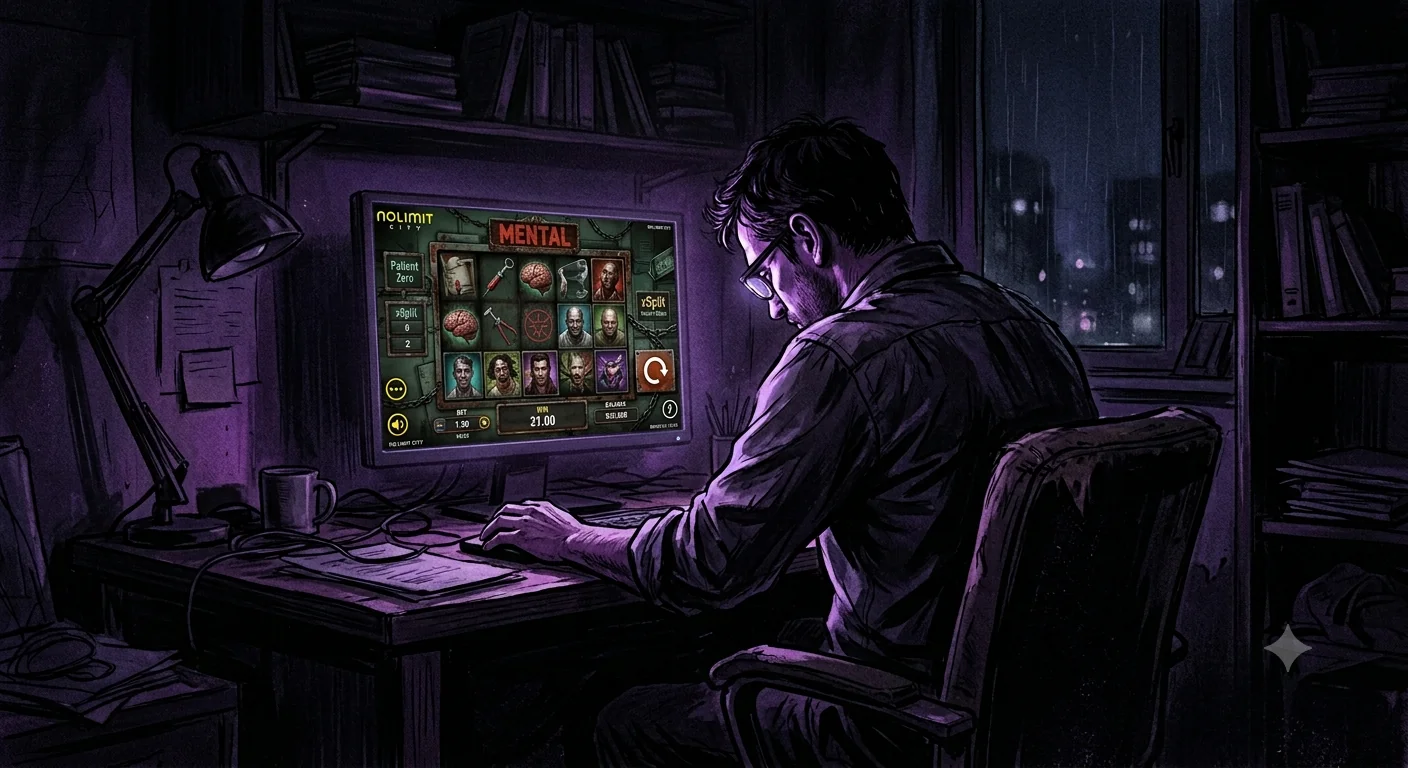
They called him Thomas.
Not that anyone paid much attention. At the office he was "the analyst on the third floor." At the bar he was "one more." At home he was... at home, nobody called him anything. Jana left in March. She took the cat.
What remained was the monitor. The numbers. The silence that had its own weight.
Thomas had spent his life working with data. He knew a casino couldn't be beaten. He knew it the way a physicist knows he cannot fall upward. This wasn't a feeling. It was mathematics. RTP 96.08%. House edge 3.72%. Given sufficient spins — convergence to loss.
He knew this.
And precisely because he knew it, he believed he was different.
That's what he told himself.
The first time he opened the app was a Tuesday. Just to look. Analytically. To observe how the algorithm worked — not as a player, but as a witness. A scientist in the field.
The graphics were strange. Not golden, not glossy like most. Dark. Purple. Faceless figures, numbers without context, multipliers that grew without logic — or with a logic he hadn't yet understood.
xSplit. xWays. xNudge.New mechanics. Nolimit City — a Swedish studio. He knew of them. He'd read a paper on their mathematical model. 66,666x maximum win — a number designed to look like the devil's number. Marketing through numerology. Transparent.
He stood in demo mode for five minutes.
Then he deposited twenty euros.
The first week was boring. He lost one hundred and twenty euros. He logged it in a spreadsheet as a research expense. He knew it was a loss. He knew it precisely.
The second week he had a lucky session. Plus ninety. The spreadsheet changed — he added a "cumulative" column. Minus thirty overall. Acceptable.
The third week he noticed he was opening the app before his morning coffee.
His boss told him his last report had errors. Thomas looked at the report. His boss was right.
For the first time in seven years.
He sat in the office and didn't think about the errors in the report. He thought about the session from two days before. He'd had an xSplit on the fourth reel and suddenly it vanished. How? He recalculated. Again. He must have made an error. The algorithm wasn't random — it was pseudorandom. Seeds. Sequences. If he could know the seed—
He knew that.
Jana called on Saturday. She wanted to know how he was doing. It was a kind gesture from someone who didn't need to want anything from him.
"Fine," he said. "I'm working on a project."
"What project?"
A pause. Four seconds. He counted them.
"Analytical."
Jana asked if he was sleeping enough. He said yes. He'd slept four hours. He'd spent the rest of the night in the spreadsheet and in the game log file he'd exported from his account — the casino provided spin history for "responsible gambling." The irony hadn't escaped him.
Month four. The spreadsheet had twelve tabs. RTP per session, volatility per sample, win distribution by bet size, correlation analysis between time of day and outcome (no correlation, he knew this, but he verified), frequency analysis of bonus triggers.
Minus four thousand two hundred.
The number was in cell G47. Red. Excel automatically formatted negative numbers in red.
He closed the spreadsheet. He opened the app.
It was a game designed for people like him.
Not for the impulsive. Not for those who don't understand mathematics. For those who understand — and precisely because of that, search for a system. A pattern. An exception to the rule they can cite themselves.
Nolimit City knew this. That's why xWays works the way it works — with a mechanic the brain perceives as almost logical. Almost understandable. Just one more spin and I'll understand.
Just one more.
In May he lost his job.
Not directly because of the game. Directly because of reports with errors, meetings where his mind was elsewhere, deadlines that passed unnoticed.
He sat in the flat and thought: Now I have time to analyse.
This was the moment.
Not the fall — the fall had happened long ago, quietly, in increments of twenty euros. This was the moment he understood that he had fallen.
And he opened the app.
Outside it was day. Or night. The curtains had been drawn since last week — he couldn't remember why he'd drawn them, only that there was some light that was bothering him from the monitor.
He stopped.
The number in cell G47 stopped at minus eighteen thousand and four.
He opened the spreadsheet for the last time in June. He added the final entry. He closed it.
He didn't open it again.
Not because he stopped. Because he stopped counting.
Mental always loads where you left off.
Continue?
YES / NO
Thomas always clicked YES.
You are free.