Kenya Gambling Law 2026
Gambling Control Act 2025 · Gambling Regulatory Authority · Online Rules · Tax
Quick Take
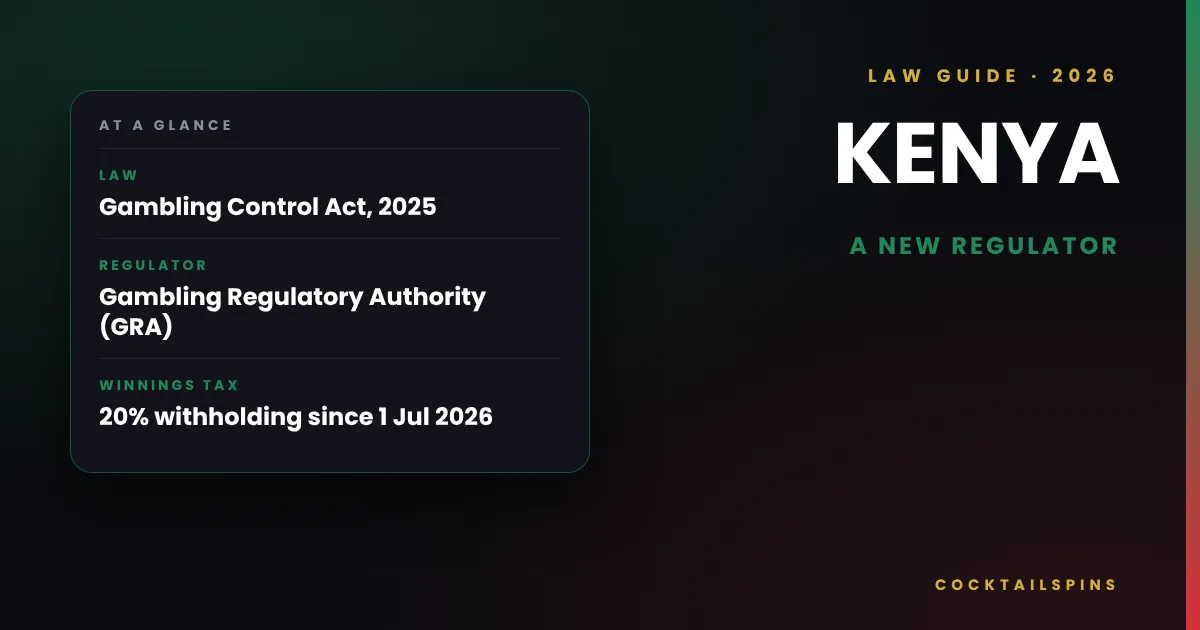
- The Gambling Control Act, 2025 replaced laws dating from the 1960s and created the Gambling Regulatory Authority, which succeeds the Betting Control and Licensing Board.
- Regulations issued on 30 June 2026 require online operators to use geolocation, connect to the regulator’s central monitoring system and store player data in Kenya.
- Since 1 July 2026, a 20% withholding tax is deducted from betting winnings before they are paid out.
📌 Informational guide: this page explains the law in Kenya. Cocktailspins does not list, rank or link to gambling operators for players in Kenya. Rules change — follow updates in our Regulation Tracker.
The New Law
Kenya modernised its gambling law with the Gambling Control Act, 2025 (Act No. 14 of 2025), which replaced the Betting, Lotteries and Gaming Act from the 1960s. The Act created the Gambling Regulatory Authority (GRA), successor to the Betting Control and Licensing Board, with powers to license, vet, monitor transactions in real time, inspect and enforce. Online gambling is a licensed category, and unlicensed foreign operators are prohibited unless they register locally and meet all Kenyan requirements.
Player Protection
Licensed operators must register players with verified identification, keep player funds in separate accounts, offer self-exclusion, avoid inducements and player credit, and certify their games for fairness. Monetary winnings must be paid within two days. Advertising must not target minors or vulnerable people, and unlawful advertising is an offence.
The 2026 Online Regulations
Subsidiary regulations issued on 30 June 2026 set the technical rules for online platforms: robust geolocation, real-time monitoring through a secure API, integration with the Authority’s central monitoring system and the national gambling register, and storage of player data on servers in Kenya unless the regulator grants an exemption. Licensees serving markets outside Kenya need paid-up capital of KES 100 million and a KES 200 million bond, and must block access from people located in Kenya.
Court challenge. The Licensing Regulations 2026 were suspended by the High Court on 20 July 2026 and largely reinstated in August, so licensing can proceed. The court let the authority process applications and collect the disputed fees on an undertaking to refund anything later found unlawful; reports differ on how far those fees can be enforced. A judgment due on 2 October 2026 was not delivered and the file was listed for mention on 12 October. We have not found the outcome of that hearing, so check the regulator's notices for the current position.
Penalties
Offences under the Act carry fines of KES 1 million to 20 million and imprisonment of up to 20 years, along with forfeiture of licences and equipment and disqualification from holding a licence for up to five years. Directors and senior managers can be personally liable.
Tax on Winnings
Kenya’s gambling taxes have changed several times. Under the Finance Act 2025, winnings were taxed at 5% on withdrawal from October 2025. The Finance Act 2026, in force from 1 July 2026, introduced a 20% withholding tax on betting winnings, deducted by the operator before payment: a KES 100,000 win pays out KES 80,000.
Crypto
Kenya enacted a Virtual Asset Service Providers Act in 2025, bringing crypto exchanges and similar services under licensing. A crypto payment does not exempt a gambling operator from the Gambling Control Act. For how stablecoin transfers work, see our USDT TRC20 explainer.
Our Position and Help
This page explains the law and does not list or link to gambling operators. BeGambleAware offers free, confidential guidance, our Responsible Gambling Score explains what good player protection looks like, and our AFCON 2027 guide covers the tournament Kenya co-hosts.
FAQ
Who regulates gambling in Kenya?
The Gambling Regulatory Authority, created by the Gambling Control Act, 2025, which replaced the Betting Control and Licensing Board.
How are betting winnings taxed in Kenya?
Since 1 July 2026, a 20% withholding tax is deducted from winnings before payout under the Finance Act 2026.
Can foreign online casinos operate in Kenya?
Only if they register locally and meet all Kenyan licensing requirements. Unlicensed foreign operators are prohibited.
What are the penalties under the Gambling Control Act?
Fines of KES 1 million to 20 million and up to 20 years in prison, plus forfeiture and disqualification.