Self-Exclusion Schemes Compared: GamStop, BetGuard, OASIS and CRUKS
Several regulated markets now run one central register that lets a person block themselves from every licensed operator at once. Here is how the four best-known schemes differ, what each source actually says and where the numbers come from.
Quick Take
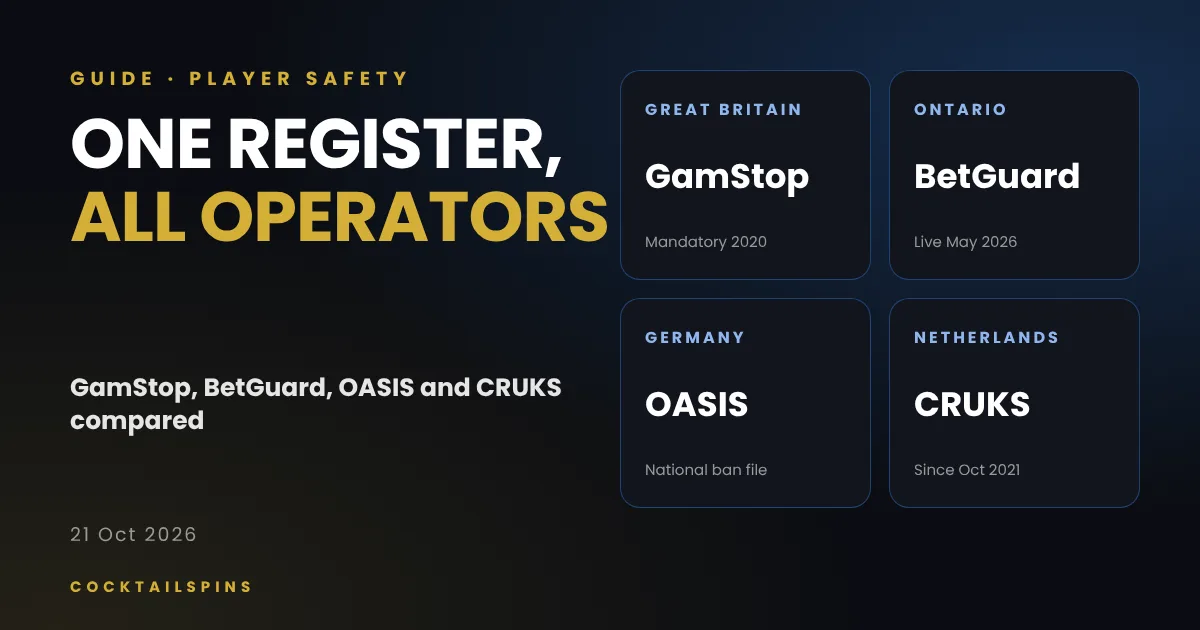
- Great Britain, Ontario, Germany and the Netherlands each run a central self-exclusion register. One registration is meant to cover all licensed operators in that market.
- Each scheme binds operators licensed in its own jurisdiction. The sources we checked do not say any of them reaches sites that hold no local licence, so do not assume it does.
- Terms differ: Ontario offers six months, one year or five years; the Netherlands has a six-month minimum with an eight-day reflection period before you can leave.
- Published counts come from different dates and sources, so they are not comparable across schemes.
The Idea in One Paragraph
A central self-exclusion scheme turns a personal decision into a single step. Instead of contacting each casino or betting site, a person registers once and every licensed operator in that market has to keep them out. Regulators in Great Britain, Ontario, Germany and the Netherlands run versions of this. They differ in who runs the register, how long a ban lasts and what happens when you want to leave it.
At a Glance
| Scheme | Where | Who has to take part | Mandatory since |
|---|---|---|---|
| GamStop | Great Britain | All online gambling operators licensed in Great Britain | 31 Mar 2020 |
| BetGuard | Ontario, Canada | All operators regulated in Ontario (standard 2.14.1) | 14 May 2026 |
| OASIS | Germany | Land-based venues and legal online gambling are linked (see below) | Not covered in our sources |
| CRUKS | Netherlands | Licensed online and land-based gambling providers | 1 Oct 2021 |
GamStop (Great Britain)
The UK Gambling Commission announced on 14 January 2020 that all online gambling operators must take part in the multi-operator scheme GAMSTOP, with a deadline of 31 March 2020 (UK Gambling Commission). iGaming Business reports the same announcement and describes it as applying to online operators licensed in Great Britain. The Commission says a person can exclude from all participating online operators with a single request, instead of contacting each one.
BetGuard (Ontario)
Ontario’s Centralized Self-Exclusion Program is run by iGaming Ontario under the name BetGuard. The regulator, the AGCO, published its new standard in a bulletin dated 2 April 2026: “Operators shall participate in the Centralized Self-Exclusion Program” (AGCO bulletin). The AGCO says the standards took effect on 14 May 2026, when BetGuard launched (AGCO), and Covers and Casino.org give the same launch date.
| Rule | What the AGCO says |
|---|---|
| Terms | Six months, one year or five years (AGCO). Casino.org adds a custom term. |
| Registry update | iGaming Ontario must add a registrant no later than one hour after registration. |
| Marketing and promotions | Operators must stop them within 24 hours of the person being added. |
| Open wagers | Cancelled and refunded within 24 hours, unless the person was added less than 24 hours before the deciding event. |
| Operators’ own programs | Operators keep their site-level programs for now. The AGCO says it will revisit that requirement within 12 months of launch. |
Covers says people do not need an existing iGaming account to sign up and that identity must be confirmed. Casino.org says people aged 19 or older can use it and reported, citing an industry source, more than 500 registrations in the first two weeks.
Where outlets disagree: the number of participating sites. Casino.org counts 77 sites from 44 operators plus the OLG Proline platform; Covers says more than 70 sites from more than 40 operators; a pre-launch report from Sigma said 82. We do not give a count, because the list changes. The regulated list is the reference.
OASIS (Germany)
Germany’s national ban file is OASIS. According to hessenschau, it is run by the Regierungspräsidium Darmstadt and held about 367,000 active bans in February 2026. The same article reports more than 5.2 billion queries in 2025, about 200 million more than in 2024, and says about 9,000 operators with roughly 41,000 locations are connected, with legal online gambling linked as well. In March 2025 the figure was 318,104 active bans, reported by Casino.org Germany from the responsible authority via an industry association.
The 367,000 figure comes from a single outlet; the 2025 figure comes from another. Both are dated and neither is a current count.
CRUKS (Netherlands)
The Dutch register is run by the Kansspelautoriteit (KSA) and went live on 1 October 2021, when the Dutch online market opened (Gambling Insider). Licensed providers must check it (Gambling Insider, SBC News). An update on 25 April 2023 kept the six-month minimum and added an eight-day reflection period before a person can unsubscribe, replacing the earlier one-click removal, according to Gambling Insider. Both outlets reported more than 38,000 registrations by then. The register’s own site is cruksregister.nl.
Numbers, With Dates
| Scheme | Figure | Date | Source |
|---|---|---|---|
| OASIS | 318,104 active bans | March 2025 | Casino.org Germany |
| OASIS | About 367,000 active bans | Feb 2026 | hessenschau |
| CRUKS | More than 38,000 registrations | Apr 2023 | SBC News, Gambling Insider |
| BetGuard | More than 500 registrations | First two weeks | Casino.org (industry source) |
These are not like for like: they count different things (active bans, cumulative registrations) over different periods in markets of very different size. Use each one only for its own scheme.
📌 In our view: the schemes are converging on the same design: one register, fast propagation to operators and limits on quick reversal. Ontario’s one-hour and 24-hour deadlines and the Dutch eight-day reflection period are the most concrete rules in the sources we checked. What the sources do not show is how well any scheme works in practice, so we make no claim about effectiveness.
What This Means for Players
💡 What this means for players: if you live in one of these markets and want a break, the register for your market is the official route, and it only reaches operators licensed there. Sites without a local licence are outside it, so a ban does not protect you from them. Choose the term carefully: Ontario offers fixed terms, and in the Netherlands you cannot leave before six months and then wait eight days. If gambling is causing harm, free support is available from BeGambleAware and GamCare in Great Britain. This is information, not advice.
Cocktailspins Weekly Brief
One email a week: the regulation changes, market news and events that matter for crypto gambling. Verified, no spam.
18+ only. Unsubscribe any time. See our privacy policy.FAQ
What is GamStop?
A multi-operator self-exclusion scheme for online gambling in Great Britain. The UK Gambling Commission required all online operators licensed there to take part from 31 March 2020.
What is BetGuard?
Ontario’s Centralized Self-Exclusion Program, run by iGaming Ontario. It launched on 14 May 2026 and all operators regulated in Ontario must participate.
How long can I exclude myself in Ontario?
Six months, one year or five years under the AGCO standard. Casino.org also reports a custom term.
What is OASIS in Germany?
The national ban file run by the Regierungspräsidium Darmstadt. Hessenschau reported about 367,000 active bans in February 2026.
What is the minimum term in the Netherlands?
Six months in CRUKS. Since an update on 25 April 2023 there is also an eight-day reflection period before a person can unsubscribe.
Do these schemes cover casinos that have no local licence?
The sources we checked do not say so. Each scheme binds operators licensed in its own market, so do not assume it blocks unlicensed sites.
Sources
↗ UK Gambling Commission — Online operators required to participate in GAMSTOP from March 2020 (14 Jan 2020) ↗ iGaming Business — GamStop to become mandatory for GB licensees ↗ AGCO — Information bulletin: iGaming standards for the Centralized Self-Exclusion Program (2 Apr 2026) ↗ AGCO — Centralized self-exclusion standards now in effect (14 May 2026) ↗ Covers — Ontario launches unified self-exclusion system (14 May 2026) ↗ Casino.org — BetGuard tops 500 self-exclusions in first two weeks (27 May 2026) ↗ Sigma — Ontario launches centralised self-exclusion system for iGaming ↗ hessenschau — Over five billion OASIS queries (10 Feb 2026) ↗ Casino.org Germany — Number of OASIS bans keeps rising (July 2025) ↗ SBC News — KSA upgrades CRUKS (25 Apr 2023) ↗ Gambling Insider — KSA releases updated self-exclusion scheme in the Netherlands18+ only. Gambling laws differ by country and change quickly — check the rules where you live. If gambling stops being fun, BeGambleAware and GamCare offer free, confidential support.