Bitcoin gambling legal status in Japan — Penal Code restrictions, 2025 revised law targeting affiliates, NPA enforcement, FSA crypto regulation and IR casino development explained.
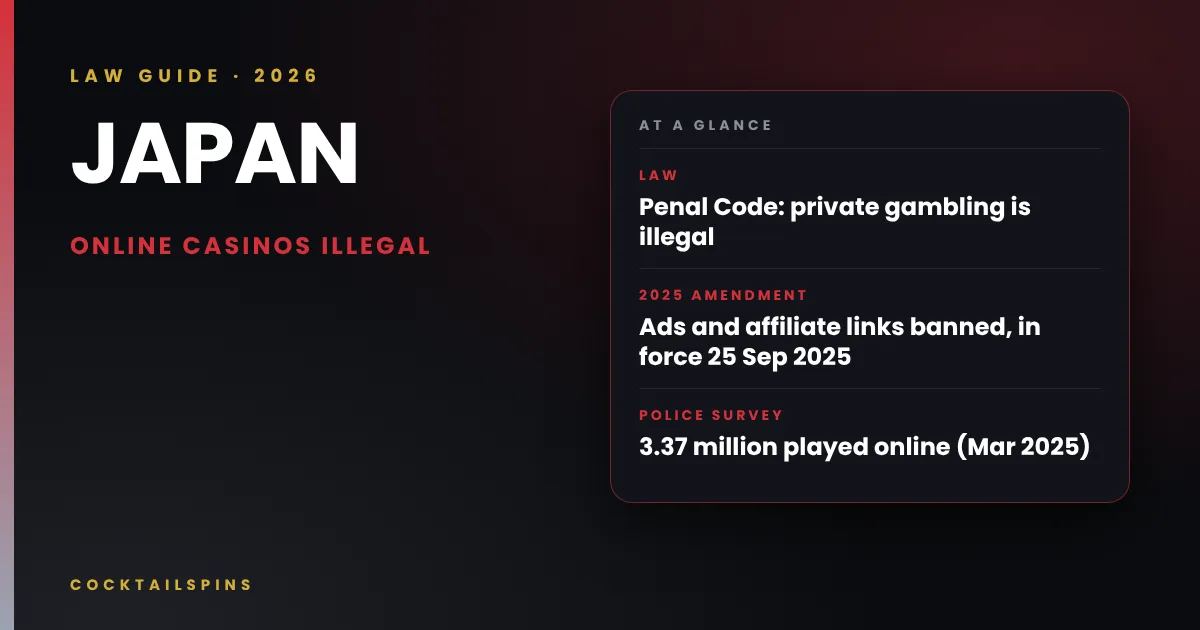
⚠️ Important legal notice for Japan: Online gambling, including crypto casino gambling, is illegal for Japanese residents under the Penal Code Article 185. Japan's revised gambling law (September 2025) explicitly prohibits affiliate websites directing Japanese users to offshore casinos. The NPA actively prosecutes offshore casino users and affiliates. This page is an informational regulatory overview only. Cocktailspins does not recommend or promote illegal gambling activity to residents of Japan.
📌 Japan keyword insight 2026: Japanese players and researchers search primarily for "japan crypto casino", "bitcoin casino japan" and "オンラインカジノ ビットコイン" (online casino bitcoin). Japan has one of the world's highest cryptocurrency adoption rates — the FSA has licensed over 30 domestic crypto exchanges. Despite strict gambling prohibitions, Japan's crypto-savvy population generates significant search volume for bitcoin casino content. Bitbank and bitFlyer are Japan's two most-used FSA-licensed exchanges. The 2025 revised law represents a significant tightening of enforcement compared to the pre-2024 environment.
Japan's gambling prohibition traces to the Meiji era and remains one of the strictest in developed economies. Penal Code Article 185 makes gambling a criminal offence, with fines up to 500,000 yen for individual players. Article 186 provides enhanced penalties for habitual gambling and those who profit from gambling operations.
Critically, the law applies to Japanese residents regardless of where the casino is located. Accessing an offshore online casino — even one licensed in Curaçao or Anjouan — from Japan is illegal gambling under the Penal Code. This position was formally reaffirmed by the National Police Agency in 2023 and enforcement has intensified significantly since 2024.
Limited exceptions exist for government-approved public gambling: horse racing (JRA and regional), bicycle racing, motorboat racing, and national/regional lotteries. These are tightly regulated, run by public bodies, and generate significant tax revenue for municipal governments. Online betting on these approved formats is permitted through official licensed platforms.
The most significant development for the online casino sector was the revised online gambling law that took effect in September 2025. The revision explicitly extended the prohibition to include:
Affiliate and recommendation websites — sites that rank, review or recommend offshore online casinos to Japanese users are now expressly prohibited. The law identified the affiliate infrastructure as a key enabler of illegal gambling growth, citing that over 40% of Japanese online casino users first encountered these platforms through social media and recommendation sites.
Social media promotions — influencers and content creators directing Japanese followers to offshore gambling platforms are covered by the revised law. Multiple TV celebrities and professional athletes have been referred to prosecutors since February 2025 for similar conduct.
The law does not carry specific criminal penalties itself but strengthens the administrative framework for enforcement actions. The National Police Agency, Ministry of Internal Affairs and Communications, and Ministry of Economy, Trade and Industry (METI) all have expanding roles in enforcement under the revised framework.
57 individuals referred to prosecutors for using offshore online casinos via cryptocurrency, including a firefighter. First major group enforcement action targeting individual users.
Three arrested for operating affiliate-style service directing ~10,000 players to overseas casinos. Operated a paid Discord community charging ¥10,000 membership for gambling strategies.
Multiple TV comedians and professional athletes referred to prosecutors for using offshore online casinos. High-profile cases raised public awareness of enforcement risk.
Revised gambling law takes effect — affiliate sites explicitly prohibited. NPA announces expanded enforcement program.
Bitbank froze accounts connected to Polymarket on June 15, 2026 — Penal Code Article 185 cited for crypto event-contract trading. All account functions suspended including withdrawals.
Despite strict gambling laws, Japan has one of the world's most developed cryptocurrency regulatory frameworks. The Financial Services Agency (FSA) licenses crypto exchanges under the Payment Services Act, and Japan was among the first countries globally to establish a formal licensing regime for crypto assets.
| Exchange | FSA Licensed | JPY Support | Status 2026 |
|---|---|---|---|
| bitFlyer | ✓ | ✓ | Largest by volume |
| Bitbank | ✓ | ✓ | Froze Polymarket accounts Jun 2026 |
| Coincheck | ✓ | ✓ | Acquired by Monex Group |
| GMO Coin | ✓ | ✓ | Active, full product range |
| SBI VC Trade | ✓ | ✓ | Bank-backed, institutional focus |
FSA-licensed exchanges are legally required to report suspicious transactions to the Japan Financial Intelligence Center (JAFIC). Under the 2025 Payment Services Act amendment, stricter rules apply to overseas fund transfer services — FSA-licensed exchanges that detect transactions connected to online gambling sites may be required to block or report them.
Japan's only path to legal domestic casino gambling is through the Integrated Resort (IR) Implementation Law of 2018. IRs are large-scale entertainment complexes — casinos, hotels, convention centers, international exhibition spaces — licensed under a comprehensive framework.
Osaka IR (Yumeshima artificial island) is the most advanced, targeting a 2030 opening. MGM Resorts and Orix Corporation hold the operating licence. Osaka will become one of the largest casino complexes in Asia, with an estimated ¥1.08 trillion ($7.3B) investment.
Nagasaki IR (Huis Ten Bosch resort) is the second confirmed IR, with Casinos Austria International Japan holding the licence. Under current planning, IR casinos will not accept cryptocurrency deposits — all transactions are expected to be in JPY through regulated payment channels.
| Activity | Legal Status | Regulator |
|---|---|---|
| JRA Horse Racing (online) | Legal ✓ | JRA (licensed) |
| Public Sports Betting (SPAT4) | Legal ✓ | JKA (licensed) |
| National/Regional Lottery | Legal ✓ | Government operated |
| Pachinko/Pachislot | Grey area (prize exchange) | NPA / Prefectural police |
| IR Land-based Casino (from 2030) | Legal (when open) | Japan Casino Regulatory Commission |
| Offshore Online Casino | Illegal ✗ | NPA enforcement |
| Crypto Casino (offshore) | Illegal ✗ | NPA / FSA enforcement |
| Affiliate/Recommendation Sites (JP users) | Illegal from Sep 2025 ✗ | NPA / METI |
No — online gambling is illegal under Penal Code Article 185, including access to offshore crypto casinos. NPA actively enforces and has referred multiple individuals to prosecutors since 2024. Legal exceptions: horse racing, public sports betting, lotteries.
September 2025 revision explicitly prohibits affiliate websites and recommendation sites directing Japanese users to offshore casinos. Social media promotions also covered. Entire affiliate infrastructure around online gambling is now expressly illegal.
Yes — FSA regulates crypto exchanges under the Payment Services Act. 30+ licensed exchanges including bitFlyer, Bitbank, Coincheck. Buying, holding and trading crypto is fully legal. Crypto does not override gambling prohibition — using crypto at offshore casinos remains illegal under the Penal Code.
Osaka IR (MGM/Orix) targets 2030 on Yumeshima island. Nagasaki IR (Casinos Austria) is the second confirmed licence. IR casinos will be land-based only — no online gambling component. Cryptocurrency deposits not currently planned.
Bitbank froze all accounts connected to Polymarket on June 15, 2026, citing Penal Code Article 185 — classifying crypto event-contract trading as gambling. All login, trading and withdrawal functions were suspended. No large-scale enforcement of individual Polymarket users reported as of mid-2026.
Japan (population 125M, currency JPY) operates under No online gambling regulator — casino gambling illegal under Penal Code Art. 185. The governing legislation is the Penal Code Article 185 — gambling illegal except pachinko, horse racing, lottery. Japan has the strictest no-casino stance in Asia yet ranks consistently in top 10 global crypto casino markets. The paradox: 20 million pachinko players seeking digital alternatives + FSA-regulated exchanges (bitFlyer, Coincheck) making USDT purchase trivially easy. JPY-to-USDT in 5 minutes via Japan Post Bank or Aeon Bank integration.
For crypto casino players, the regulatory picture creates a clear opportunity: Illegal but unenforced for individuals — offshore crypto casino widely used. USDT TRC20 deposits bypass all fiat payment restrictions because they are peer-to-peer blockchain transfers — not processed by Japann financial institutions and therefore outside the scope of the gambling payment restrictions that block debit cards at unlicensed sites.
bitFlyer (Tokyo, FSA-licensed) is the primary route for Japann players. Coincheck (Tokyo, FSA-licensed) and SBI VC Trade are reliable alternatives available via SEPA bank transfer. The complete process: register at exchange → verify identity (required at exchange level, not at casino) → deposit JPY via bank transfer or card → buy USDT → withdraw on TRC20 network → deposit at casino. Total time from bank transfer to casino deposit: under 30 minutes on first setup, under 5 minutes for repeat deposits.
| Exchange | JPY Deposit | USDT TRC20 | Regulated | Time to Casino |
|---|---|---|---|---|
| bitFlyer | Bank transfer, card | ✓ | Yes ✓ | Under 5 min |
| Coincheck | SEPA, card | ✓ | EU MiCAR ✓ | Under 5 min |
| SBI VC Trade | SEPA | ✓ | Regulated ✓ | 5-10 min |
| Binance P2P | Bank transfer, cash | ✓ | MiCAR EU ✓ | Under 5 min |
Players in Japan who access offshore crypto casinos do so for specific, practical reasons that licensed domestic alternatives cannot address. First: game selection. Licensed operators in most jurisdictions restrict bonus buy features, certain high-volatility Nolimit City titles, and crash games. Offshore crypto casinos offer the complete global library — 8,000+ games from 80+ providers with no restrictions.
Second: deposits and withdrawals. Licensed operators in Japan must process through regulated payment networks subject to bank blocking and AML checks. USDT TRC20 at offshore crypto casinos confirms in 1-3 minutes with no bank approval process. Withdrawals process in under 10 minutes 24/7 — no waiting for business hours or manual review.
Third: no KYC for standard play. BC.Game and Rollbit require only email registration for deposits under $2,000 USDT. No ID document, no proof of address, no source of funds. Players who value privacy — or who have had accounts refused at licensed sites — use offshore crypto casinos as the alternative.
| Factor | Offshore Crypto Casino | No casinos — pachinko parlours only (considered skill game) |
|---|---|---|
| KYC Required | No (under $2k) | Full KYC mandatory |
| Deposit Method | USDT TRC20 — 1 min | Bank card — may be blocked |
| Withdrawal Speed | Under 10 min | 1-5 business days |
| Game Selection | 8,000+ no restrictions | Limited, bonus buys banned |
| Stake Limits | No limits | Often capped |
| Bonus / Rakeback | Up to 15% rakeback daily | Heavy wagering requirements |
| Crypto Accepted | BTC, ETH, USDT, 300+ | Fiat only |
Offshore crypto casino use in Japan carries the same risks as any form of gambling. The absence of KYC and deposit limits means individual players must apply their own controls. BC.Game, Rollbit and Cloudbet all offer voluntary deposit limits, loss limits and self-exclusion — these must be activated manually in the account settings.
If gambling is causing financial harm, contact your national responsible gambling support: BeGambleAware.org (international) or your country-specific helpline. See our Responsible Gambling Score for how we rate casinos on player protection tools.
Illegal but unenforced for individuals — offshore crypto casino widely used. Individual players are not prosecuted. No online gambling regulator — casino gambling illegal under Penal Code Art. 185 focuses enforcement on operators, not players. USDT TRC20 deposits bypass payment restrictions entirely as they are blockchain-level transfers.
bitFlyer (Tokyo, FSA-licensed) is the recommended starting point — regulated, reliable, good JPY on-ramp. Coincheck (Tokyo, FSA-licensed) and SBI VC Trade are solid alternatives. Always withdraw USDT on TRC20 — under $1 fee, 1-3 minute confirmation.
Banks may block card transactions to identified gambling merchants. USDT TRC20 bypasses this entirely — it is a blockchain transfer between wallets, not a bank card transaction. The bank never sees the gambling destination.
BC.Game (no KYC under $2,000 USDT), Rollbit (no KYC entirely), Cloudbet (no KYC under $1,000). All accept USDT TRC20 with 1-3 minute deposit confirmation.
Under 10 minutes at BC.Game, Rollbit and Cloudbet. TRC20 network confirms in 1-3 minutes. No bank processing delay — funds go wallet-to-wallet.
Yes — all major slot providers (Pragmatic Play, Nolimit City, Hacksaw Gaming, NetEnt) are available at offshore crypto casinos accepting Japan players. Gates of Olympus, Mental, Dead or Alive 2, Sweet Bonanza — all accessible with USDT TRC20.