Philippines Online Gambling Rules 2026
PAGCOR · POGO Ban · E-Wallet Delinking · Advertising Limits
Quick Take
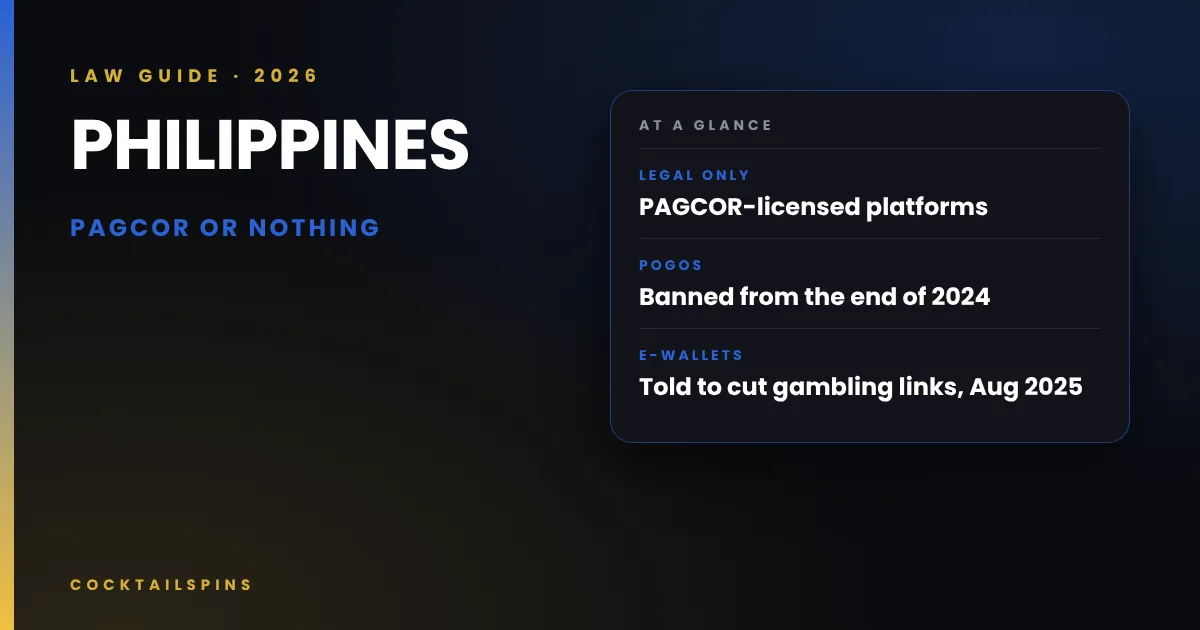
- Online gaming is legal in the Philippines only on platforms licensed by PAGCOR. Offshore gaming operators (POGOs) serving foreign players were banned from the end of 2024.
- On 14 August 2025 the central bank ordered e-wallets including GCash and Maya to remove links to gambling sites. PAGCOR’s monthly income fell from ₱5.7bn in May to ₱2.9bn in September 2025.
- Gambling ads are banned in prime time and on billboards, KYC is required before a first deposit, and the Senate resumed hearings on online gambling in February 2026.
📌 Informational guide: this page explains the law in Philippines. Cocktailspins does not list, rank or link to gambling operators for players in Philippines. Rules change — follow updates in our Regulation Tracker.
What Is Legal
The Philippine Amusement and Gaming Corporation (PAGCOR) is both a regulator and a state gaming operator. It licenses domestic online gaming, often called e-games, and players in the Philippines may legally play only on PAGCOR-licensed platforms. Unlicensed sites are illegal and are reported for blocking: PAGCOR said in 2025 that 93% of the 13,399 illegal sites reported since 2022 had been blocked.
The End of POGOs
Philippine offshore gaming operators, or POGOs, were licensed companies that offered online gambling to players outside the country. After a series of criminal investigations, President Marcos announced a ban in July 2024 and POGO operations were ordered to end by the close of 2024. The ban concerns operators serving foreign markets; it did not abolish the domestic licensed market.
E-Wallets Cut the Link
The biggest change for players came from the payment side. On 14 August 2025 the Bangko Sentral ng Pilipinas ordered e-wallet providers, including GCash and Maya, to remove the links and icons that sent users to gambling sites. The effect was immediate: PAGCOR’s monthly income fell from ₱5.7 billion in May to ₱2.9 billion in September 2025, a drop of about 49%, and around 60% of its income comes from online gambling. PAGCOR has said some players moved to illegal sites, and it has asked the central bank to reconsider the order. The central bank was also preparing rules on betting and top-up limits and on blocking the use of online loans for gambling.
Advertising and KYC
According to PAGCOR Chairman Alejandro Tengco, gambling ads are already prohibited during prime time, from 5:30pm to 8:30pm, and out-of-home advertising such as billboards has been banned. A total ban on TV and radio advertising was under consideration in early 2026. Players must now complete initial know-your-customer checks before they can make a first deposit.
Ban or Regulate?
Senators including Sherwin Gatchalian and Erwin Tulfo have criticised the growth of domestic online gaming, and bills in the House proposed restrictions ranging from limits on e-wallet promotion to an outright ban. PAGCOR supports tighter oversight rather than a total ban. Estimates presented to the Senate put registered accounts at about 32 million and active players at around 10 million, many of them holding several accounts. The Senate Committee on Games and Amusement resumed its hearings in February 2026, and the debate is not settled.
Crypto
Crypto exchanges in the Philippines must be registered with the central bank as virtual asset service providers. A crypto payment does not make an unlicensed gambling site legal. For how stablecoin transfers work, see our USDT TRC20 explainer.
Our Position
This page explains the rules; it does not list or link to gambling operators. If gambling is causing harm, BeGambleAware offers free, confidential guidance, and our Responsible Gambling Score explains what good player protection looks like.
FAQ
Is online gambling legal in the Philippines?
Yes, but only on platforms licensed by PAGCOR. Unlicensed sites are illegal and are reported for blocking.
Are POGOs still allowed?
No. Offshore gaming operators serving foreign players were banned, with operations ordered to end by the end of 2024.
Can I deposit with GCash or Maya?
Since the central bank order of 14 August 2025, e-wallets have had to remove direct links and icons to gambling sites.
Will the Philippines ban online gambling?
It is being debated. Senators have pushed for tighter controls or a ban, while PAGCOR supports stricter regulation instead.