She came to the priest after midnight.
Father Benedek was not expecting her. No one had knocked on the rectory door at this hour since the Vásárhelyi woman three winters ago, and that had been a different kind of emergency. This woman stood in the rain without a coat, her hair flat against her face, her eyes too steady for someone who had been crying recently. He could tell she had been crying recently.
“I haven’t slept in eleven days,” she said.
He brought her inside. He made tea she did not drink. He sat across from her at the kitchen table and waited, which was what you did, which was what the training had been for.
Her name was Vera. She was thirty-one. She had a daughter, seven years old, staying with her mother now. The daughter was the reason she had finally come.
“She asked me if I was still her mother,” Vera said. “Last Tuesday. She asked me the way you ask someone a real question, not a child question. She looked at me and she asked if I was still her.”
Father Benedek said nothing.
“I didn’t know what to tell her,” Vera said.
“The cross fills from the centre. The incompleteness is the engine.”
I
It had started, she told him, the way these things always started — which was with something that felt like nothing at all.
A phone. A browser. A game that someone had shared in a group she barely checked. She had been on a waiting list for a therapist for four months and she was not sleeping and the game was free to try and the first night she had played it until three in the morning and gone to bed feeling, for the first time in a long time, like she had done something.
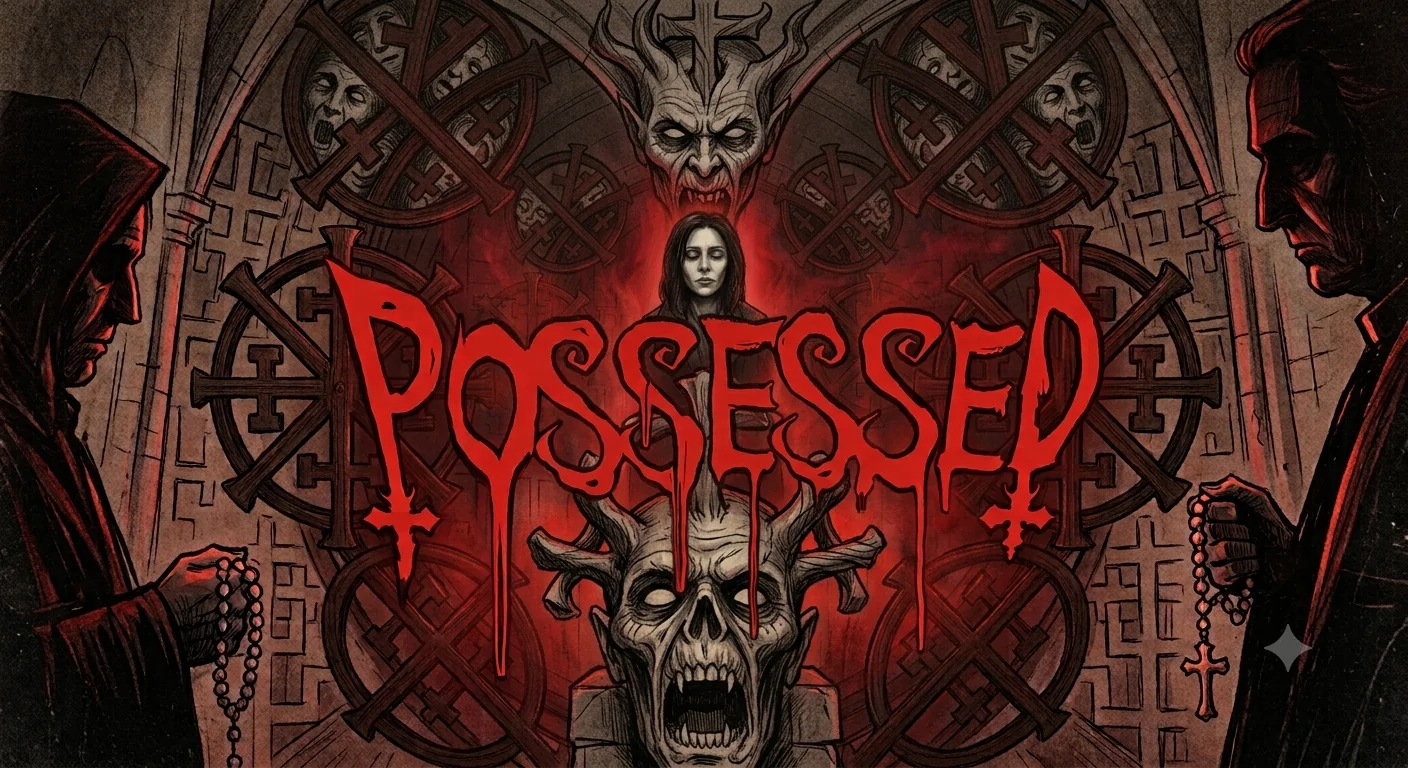
The game was called Possessed.
She described it the way people describe things they understand too well — quickly, with precision, not looking at him. An inverted cross. Three tiers of free spins: Necromancy Spins, Atonement Spins, Beelzebub Spins. The cross filled from the centre outward as the multipliers climbed. The xCrucifix wheel selecting which symbols could appear each activation. The way the highest tier — Beelzebub — activated everything simultaneously, the whole cross lit at once, the reels multiplying in ways that compounded faster than she could track.
“It went to 50,000 once,” she said. “The multiplier. That was the cap. I’d been playing for six hours and when it stopped I felt —” She paused. “I felt cheated. Like it owed me something beyond that number.”
Father Benedek recognised something in the word “owed.”
• • •
II
The deposits had started small.
Twenty euros. Then fifty. Then the feature buy — a function the game offered that let you skip directly to the bonus round at two and a half times the base stake. She had used it once, just to understand it. Then again. The logic was clean and terrible: if the bonus was where the multipliers lived, then buying directly into the bonus was simply efficient. It was not gambling on whether the bonus would come. It was paying for certainty, and then gambling only on how far the cross would fill.
She had filed the feature buy under “strategy.”
Four months in, she had lost eleven thousand euros.
Not all at once. Never all at once. The Necromancy Spins paid sometimes — modestly, inconsistently, just enough to replenish the account by a fraction. The Atonement Spins occasionally produced something she could call a win. The Beelzebub Spins she had triggered twice in four months, and both times the cross had filled and the multipliers had climbed and the result had been significant enough to reset her accounting entirely — to move the eleven thousand from the column marked “losses” to the column marked “temporary.”
She knew the column was wrong. She kept the accounting anyway.
• • •
III
“What do you want from me?” Father Benedek asked.
Not unkindly. He had stopped performing kindness for people in this state. Kindness was something they used to postpone the answer.
Vera was quiet for a moment. The rain had slowed. Somewhere in the house the boiler made a sound.
“I want you to tell me something is wrong with it,” she said. “The game. Not with me — with it. Something built into it that explains why I can’t stop. Something that isn’t just me being weak.”
“There is something wrong with it,” he said. “But it’s not what will help you.”
She looked at him.
“The game is designed around a theology of almost,” he said. “The cross fills from the centre. Each tier is named for something sacred inverted — necromancy, atonement, Beelzebub. The maximum win is called Blasphemous. It is a system built on incompleteness. The cross never fully fills for almost everyone who plays. That is not a flaw. That is the design. The incompleteness is the engine.”
“She had filed the feature buy under ‘strategy.’ Four months in, she had lost eleven thousand euros.”
IV
What Vera understood about Possessed, in the technical sense, was this: the xCrucifix was a 3×6×6×6×3 grid built around an inverted cross that filled with xActivations during free spins. The Necromancy Spins gave nine free games. Atonement gave twelve. Beelzebub gave fifteen and activated every position simultaneously. The xCrucifix Wheel selected which symbols were eligible to appear as xWays each spin, which compounded the multiplier structure in ways that were mathematically real and experientially almost impossible to follow in the moment. The 50,000x existed as a documented maximum. Someone, somewhere, had seen it once.
What she understood about it in the other sense — the sense that mattered, that lived below the data — was different. She understood that the cross filling was the most satisfying thing she had experienced in four months. Not the money. Not the number. The filling itself. The centre position activating, then the next, the cross becoming more itself with each xActivation, the promise of wholeness just one or two positions away, always just one or two positions away, the Beelzebub tier the only state in which the cross was complete and the system was finally, briefly, coherent.
The session always ended before coherence lasted.
The next session always began with the centre empty.
• • •
V
She left before morning.
She had not confessed anything. He had not asked her to. What Vera had done — the eleven thousand, the six-hour sessions, the seventeen feature buys at two and a half times base stake, methodically, one after another, each filed under the same word she no longer used in front of anyone — had been done primarily to herself. The daughter was peripheral damage. Father Benedek understood peripheral damage. He had been collecting it for a long time.
What stayed with him, after she had gone, was the cross.
The way she had described it filling. Centre outward. Three positions, four, all five lit at once in the Beelzebub state, the whole screen inverted, the multipliers compounding toward a number that the game acknowledged as its limit and then stopped. As if 50,000 was as far as the darkness went. As if there was a ceiling on it. As if the cross, fully lit, completely filled, was the end of something rather than the beginning.
He thought about this for a long time after she left.
He thought about what it meant to build a system around the promise of wholeness that almost never arrived.
He thought he had read something like this before, in a context that was supposed to be the opposite of a casino.
• • •
VI
Three weeks later, he saw her name in a photograph.
A community meeting. Civic centre on Rákóczi Street. Vera was in the second row, wearing a coat, looking at the camera. She looked like someone who had slept.
He cut the photograph out and put it in the drawer with the other things he kept — the letters, the prayer cards, the small evidence that people sometimes came through the night to the morning. Not whole. Not unwounded. But present.
The game, he assumed, was still running somewhere.
The cross waiting at its centre, empty, patient. The Beelzebub Spins waiting to be bought at two and a half times the base stake. The 50,000x waiting at a frequency of 1 in 12.7 million, inexhaustible, for whoever sat down next and needed to see the cross fill.
It was a long wait, and it had no opinion about who it was waiting for.
Only the players changed.
⚠ Responsible Gaming: This is a work of fiction exploring the human experience of gambling. The characters and events are invented. If gambling is causing you distress, help is available at BeGambleAware.org and GamCare.org.uk. Play responsibly. — See our RG Score framework.