Spain Online Gambling Law 2026
Law 13/2011 · DGOJ · Advertising Rules · 2026 Draft Reform
Quick Take
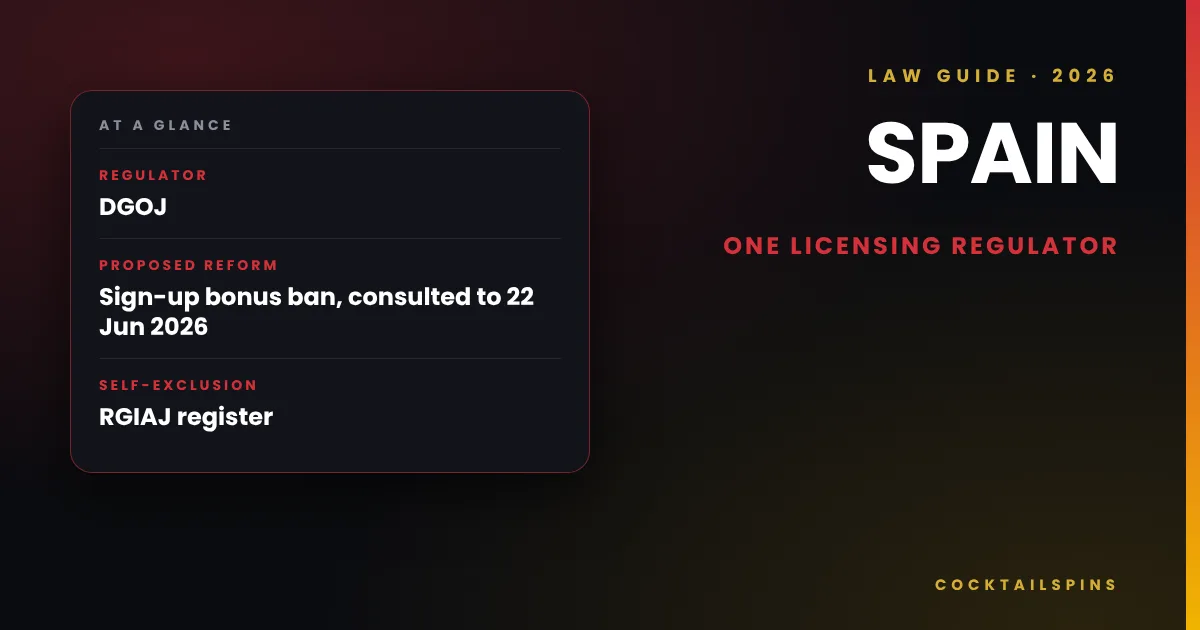
- Only operators licensed by the Directorate General for the Regulation of Gambling (DGOJ) may offer online gambling to people in Spain.
- A preliminary draft reform, consulted on until 22 June 2026, would ban sign-up bonuses and celebrity endorsements, require nominative payment methods and introduce joint deposit limits.
- Players can exclude themselves from all licensed gambling through the RGIAJ register.
📌 Informational guide: this page explains the law in Spain. Cocktailspins does not list, rank or link to gambling operators for players in Spain. Rules change — follow updates in our Regulation Tracker.
The Licensed Market
Spain regulates online gambling under the Gambling Act, Law 13/2011. The Directorate General for the Regulation of Gambling (DGOJ) issues licences, and only licensed operators — usually on .es domains — may offer online casino games, poker and betting to people in Spain. Unlicensed operators face sanctions, and the DGOJ can act against the sites and the payment providers that serve them.
Advertising Rules
Royal Decree 958/2020 imposed strict limits on gambling advertising, including on welcome bonuses and the use of celebrities. In 2024 Spain’s Supreme Court annulled several of those restrictions, finding that they needed to be set by a law of higher rank. The government’s answer is the reform below.
The 2026 Draft Reform
In 2026 the DGOJ opened a public consultation, which ran until 22 June 2026, on a preliminary draft amending Law 13/2011. Based on prior DGOJ announcements, it would restore and widen limits on gambling advertising, especially on social media and video platforms; prohibit celebrity endorsements and sign-up bonuses; limit promotions to existing customers; create a registry of B2B gambling suppliers; require nominative payment methods, ending anonymous prepaid cards; introduce joint deposit limits and standard detection of risky behaviour; and strengthen cross-border enforcement against illegal operators. It is an early draft and still needs to pass through parliament.
Self-Exclusion and Tax
The RGIAJ, Spain’s general register of gambling access bans, lets players exclude themselves from all licensed online gambling. Net gambling winnings are generally taxable as personal income in Spain; the Agencia Tributaria has the current rules.
Crypto
The EU’s Markets in Crypto-Assets Regulation (MiCA) applies: crypto-asset service providers need authorisation from a national regulator, and the transitional periods for firms operating under older national rules ended by 1 July 2026 at the latest. In Spain, the CNMV authorises crypto-asset service providers. For how stablecoin transfers work, see our USDT TRC20 explainer.
Our Position and Help
For players in Spain, this page covers the law and the licensed market only; we do not promote operators without a DGOJ licence. FEJAR, the Spanish federation of rehabilitated gamblers, offers support, and our Responsible Gambling Score explains what good player protection looks like.
FAQ
Is online gambling legal in Spain?
Yes, with operators licensed by the DGOJ under Law 13/2011.
What is changing in Spanish gambling law in 2026?
A draft reform would ban sign-up bonuses and celebrity endorsements, require nominative payment methods and add joint deposit limits. It is still a draft.
How do I self-exclude in Spain?
Through the RGIAJ register, which bars you from all licensed online gambling in Spain.
Are gambling winnings taxed in Spain?
Net gambling winnings are generally taxable as personal income. Check the Agencia Tributaria for current rules.