State of Online Gambling Regulation, October 2026
We compared 25 entries in our Regulation Tracker. The pattern: where gambling is legal, rules add more checks on identity, payments and spending. Where it is not, they now reach promotion and offshore access too.
Quick Take
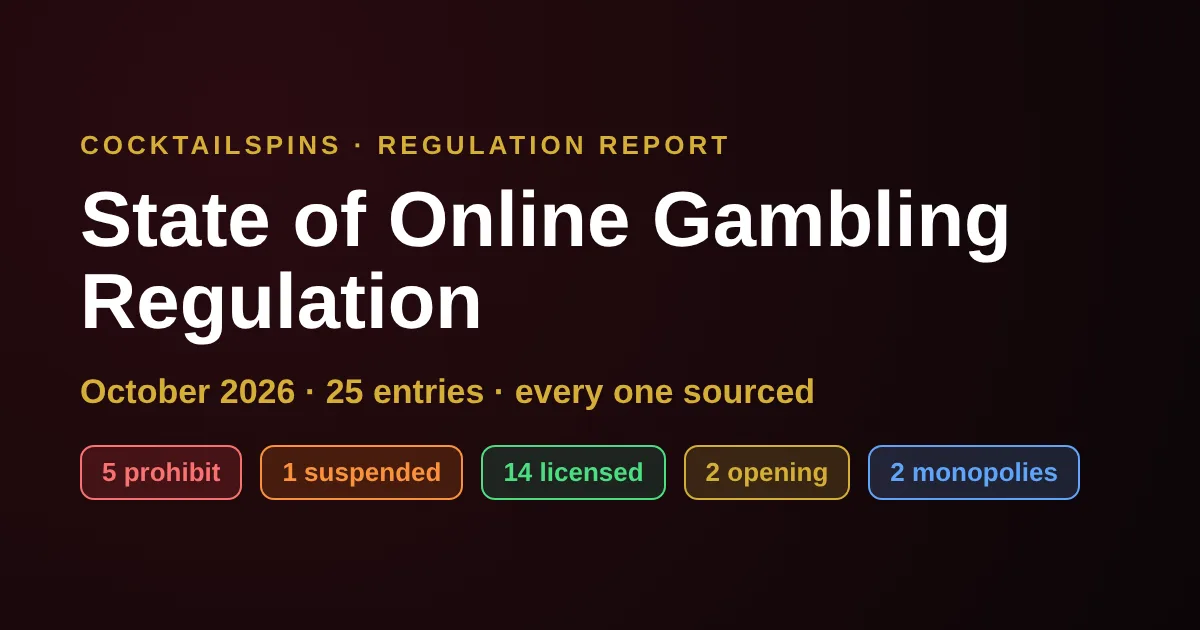
- Of 25 entries, five prohibit online gambling in some form, one is suspended, 14 are licensed markets, two are opening and two run state monopolies. Curaçao is counted as a licensing jurisdiction.
- The 2026 bans reach promotion, so affiliates are in scope as well as operators.
- Licensed markets are tightening checks on payments and spending rather than banning.
The Picture in One Chart
Entries checked between 10 and 18 October 2026. This is not a global census: it covers the markets we have verified so far.
1. Bans Now Reach Promotion
The three outright bans of 2026 all target advertising as well as operation. India’s law carries up to two years for advertising and up to three for offering or facilitating payments. Bangladesh’s covers advertising, sponsorship and affiliate marketing, with up to three years. Brazil bans advertising and intermediation in every medium. Australia’s regulator has blocked 1,774 illegal gambling and affiliate websites since November 2019, and Denmark’s pending bill would make marketing unlicensed gambling a criminal offence. In our view, for anyone who promotes gambling the line between operator and promoter is getting thinner.
2. Being Offshore Does Not Help
India’s act covers foreign operators and Bangladesh’s covers VPN-enabled gambling. Australia prohibits unlicensed services to its residents, and in Brazil all federal betting authorisations end on 25 October, although Congress still has to vote on the measure. The tracker has little to say about crypto itself: only Ghana, which passed a law to license crypto service providers in December 2025. In the bans we track, the rule follows the gambling and the player’s country, and the tracker shows no exemption for crypto.
3. Licensed Markets Add Checks, Not Bans
Great Britain caps online slot stakes at £5 per spin (£2 for 18 to 24 year olds). Sweden has banned credit-funded gambling since 1 May 2026. Spain will require the payment method to belong to the account holder from 28 October and is consulting on a common player-risk algorithm. The Netherlands has tightened its licence-application rules as the first licences come up for renewal. Germany goes the other way on stakes, raising the slot limit to €3 or €5 for eligible players, but ties it to behaviour tracking.
4. Payments Are the Lever
Four of the moves we track work through money. Sweden targets credit, Spain targets who owns the payment method, Brazil bans intermediation, and Lagos gave mobile network operators and VAS providers 30 days to verify that gaming operators on their platforms are licensed. In our reading, regulators are finding payments and intermediaries an easier lever than the websites themselves.
5. Markets Open, Slowly
New Zealand will issue up to 15 online casino licences, and unlicensed operators must stop serving the country from 1 December 2026. Finland opens its licensing system on 1 July 2027. In Africa, Kenya’s licensing continues while its fee increases are in court, Uganda renews licences every year and Tanzania taxes betting stakes at 5%. Poland and Norway keep state monopolies, and in Norway the opposition is pushing for a licensing model.
💡 What this means for players: expect more verification, and expect the name on your payment method to matter. Check the operator’s licence on the regulator’s own register (our licence-check guide shows how), and check your own country in the tracker before you deposit. For affiliates: check the promotion rules of every market you target, not only the operator rules.
Method and Limits
Every entry in the Regulation Tracker links to its sources and shows the date it was checked, and we record a fact only when two independent sources support it. Where reports disagree, we say so: for Kenya we could not confirm the outcome of the October court judgment on fees. The list is a selection, not a ranking, and rules change quickly, so use the Regulation Calendar for upcoming dates. The data can be downloaded as a CSV.
FAQ
How many markets does the report cover?
25 entries: 24 markets and Curaçao, which is a licensing jurisdiction rather than a market. It is not a global census: the entries are the markets we have verified so far, and the list grows as we verify more.
How many of them ban or prohibit online gambling?
Five entries prohibit it in some form: Brazil, India and Bangladesh ban online gambling, Australia prohibits unlicensed services to residents, and the Philippines bans offshore gaming operators. Ethiopia has suspended sports betting.
Where can I see the underlying data?
In the Crypto Gambling Regulation Tracker, where each entry shows its law, regulator, latest change, sources and verification date. The data is also available as a CSV download.
Does this report tell me whether an online casino is legal where I live?
No. It shows the pattern across markets, not legal advice for your country. Check your country's entry in the tracker, the operator's licence on the regulator's own register, and local law.
Sources
→ Crypto Gambling Regulation Tracker (all entries with their sources) → Tracker data as CSV → iGaming Regulation Calendar18+ only. Gambling laws differ by country and change quickly — check the rules where you live. If gambling stops being fun, BeGambleAware and GamCare offer free, confidential support.