Sweepstakes Casinos Explained: How They Work and Where US States Have Banned Them
Sweepstakes casinos look like online casinos but claim to be free-to-play promotions. A growing list of US states says that claim does not hold. Here is how the model works, which laws have passed and where the sources disagree.
Quick Take
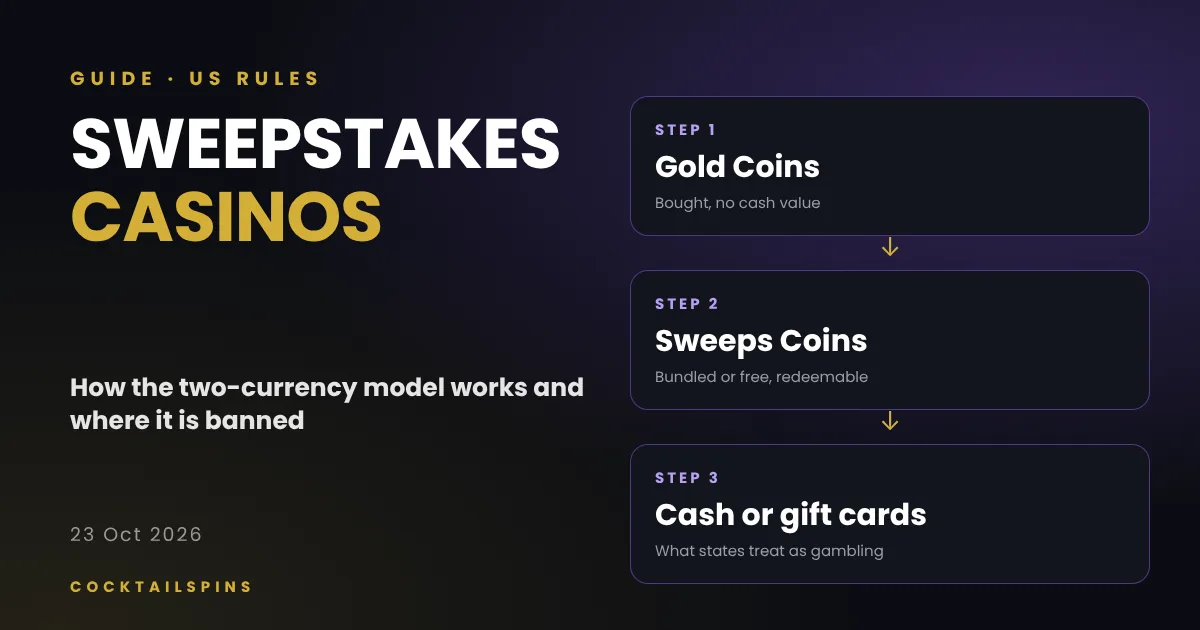
- A sweepstakes casino sells a virtual currency (Gold Coins) with no cash value and hands out a second currency (Sweeps Coins) that can be redeemed for cash or gift cards.
- Operators argue that because Sweeps Coins are given away free, there is no payment for a chance to win and so it is not gambling. Regulators and plaintiffs dispute that.
- Montana, Connecticut, New Jersey, California, New York, Indiana, Maine and Tennessee have passed laws against the model, and Oklahoma’s takes effect on 1 November 2026.
- Some laws reach beyond the operator: New York bars payment processors, geolocation providers and media affiliates from supporting these games.
- Rules change quickly. This page is a dated snapshot, not legal advice, and it names no operators.
How the Model Works
Sweepstakes casinos use two virtual currencies. Gold Coins are bought with real money and have no cash value. Sweeps Coins are free: they come bundled with Gold Coin purchases, in promotions or through a free mail-in route, and they can be redeemed for gift cards or cash prizes (Deadspin, Gaming Intelligence). The games themselves, slots, table games and live dealer, look the same as at a licensed online casino.
The Legal Argument
The operators’ case is that gambling needs consideration, meaning a payment for the chance to win. Because Sweeps Coins are given away free and a no-purchase route exists, they say nothing is staked (Gaming Intelligence). Regulators and plaintiffs argue that in practice the coins are sold together and the two currencies are one system. States that have legislated have mostly targeted the dual-currency design itself, which is why the laws below talk about dual or multi-currency games rather than about one company.
States With Laws Against It
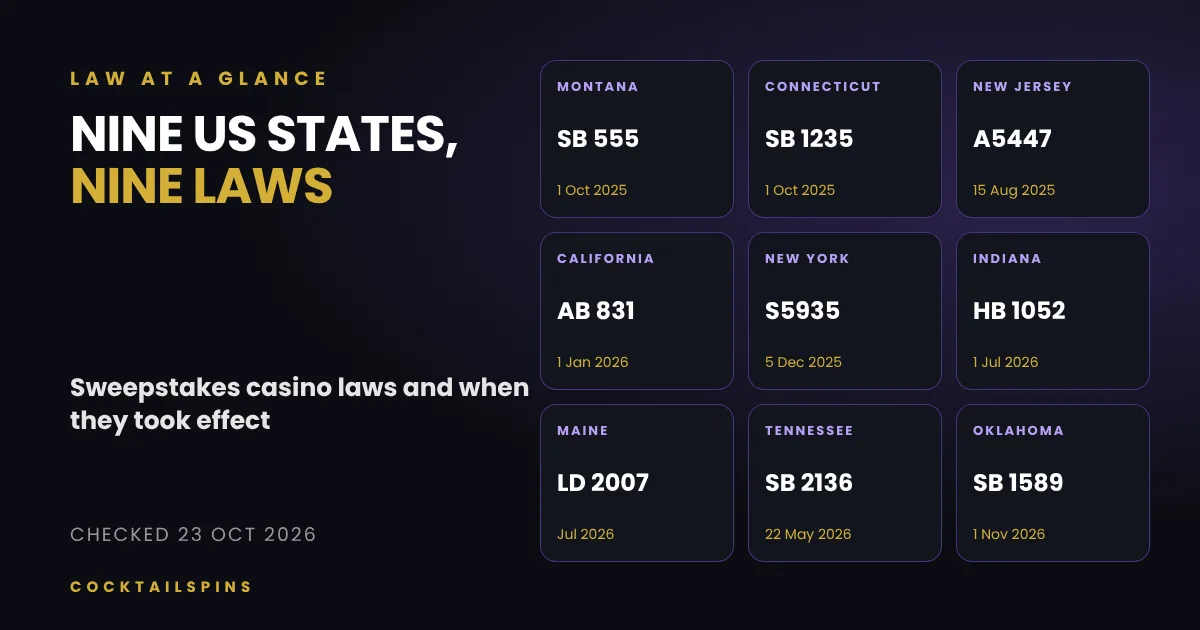
The table lists the states where at least two sources agree on the law and its dates. It is a snapshot of what we could confirm on 23 October 2026, not a complete 50-state list.
| State | Law | Signed | In effect | Sources |
|---|---|---|---|---|
| Montana | SB 555 | 2025 | 1 Oct 2025 | Action Network, Yogonet |
| Connecticut | SB 1235 (Public Act 25-112) | 2025 | 1 Oct 2025 | Action Network, Yogonet |
| New Jersey | A5447 | 15 Aug 2025 | On signing | Legal Sports Report, Sweepsy |
| California | AB 831 | 11 Oct 2025 | 1 Jan 2026 | Deadspin, Gaming Intelligence |
| New York | S5935 | 5 Dec 2025 | On signing | iGamingExpert, PlayersGaming |
| Indiana | HB 1052 | March 2026 | 1 Jul 2026 | Covers, Sweepsy |
| Maine | LD 2007 | April 2026 | July 2026 (see note) | iGamingFuture, Sweepsy |
| Tennessee | SB 2136 | 22 May 2026 | On signing | Covers, Sweepsy |
| Oklahoma | SB 1589 | Veto overridden, May 2026 (see note) | 1 Nov 2026 | iGamingFuture, Sweepsy |
Where sources differ. Maine’s effective date is given as about 14 July by iGamingFuture and 29 July by the Sweepsy tracker, so we only say July 2026. For Oklahoma, iGamingFuture dates the governor’s veto to 7 May and Sweepsy to 12 May, and the two give 15 and 14 May for the override, so we give the month only.
The laws differ in strength. Montana’s makes it a felony with up to 10 years in prison, while Connecticut treats violations as professional gambling, a Class A misdemeanor, and as an unfair trade practice (Action Network, Yogonet). New York sets fines of $10,000 to $100,000 per violation and covers anyone operating or promoting the games (iGamingExpert, PlayersGaming).
Beyond Operators: Who Else Is Covered
New York’s law also makes it unlawful for financial institutions, geolocation providers and media affiliates to support sweepstakes casinos in the state, and iGamingExpert adds payment processors, content suppliers and platform providers (iGamingExpert, PlayersGaming). That matters because it targets the supply chain, not only the brand a player sees.
Other Moves in 2026
Not every state has banned the model. Illinois sent cease-and-desist letters to operators in early 2026 while its bill SB 1705 stalled (Gaming Intelligence, Sweepsy). Idaho and Washington rely on long-standing laws (Gaming Intelligence, Sweepsy). In Louisiana, HB 53 and HB 883 moved through the legislature in May 2026 (iGamingFuture); the Sweepsy tracker lists them as signed with effect from 1 August 2026, but we found no second source for the final outcome, so Louisiana is not in the table.
How It Differs From a Licensed Casino
A licensed online casino in a regulated state is overseen by a gaming regulator and takes part in that market’s player-protection tools, such as central self-exclusion where one exists. A sweepstakes site has argued it is not gambling and sits outside that framework, which is exactly what the new laws dispute. For the player, the practical difference is that the safeguards of a licensed market may not apply.
📌 In our view: the pattern is clear. Early laws in Montana and Connecticut were followed by New Jersey, California and New York, and 2026 added Indiana, Maine, Tennessee and Oklahoma. The newer laws name the dual-currency design and the supply chain explicitly, which is a response to operators changing names and structures. Expect more states, and expect details to keep moving.
What This Means for Players
💡 What this means for players: if you live in the United States, check your own state’s current rules before using any site that sells virtual coins for casino-style games, because several states now treat it as illegal gambling. Do not rely on the “free” label. If a site you use stops working or asks you to redeem balances, follow the instructions of the state regulator or attorney general, and keep records of purchases. If gambling is causing you harm, the National Problem Gambling Helpline is available at 1-800-GAMBLER (1-800-426-2537), 24/7.
This guide is information only, not legal advice, and we do not recommend or link to any operator.
Cocktailspins Weekly Brief
One email a week: the regulation changes, market news and events that matter for crypto gambling. Verified, no spam.
18+ only. Unsubscribe any time. See our privacy policy.FAQ
What is a sweepstakes casino?
An online platform that sells a virtual currency with no cash value (Gold Coins) and gives away a second currency (Sweeps Coins) that can be redeemed for cash or gift cards. The games look like casino games.
Why do they say it is not gambling?
They argue that gambling requires a payment for a chance to win, and that Sweeps Coins are given away free with a no-purchase route. Several states have rejected that argument in law.
Which US states have banned sweepstakes casinos?
Among those we could confirm with two sources: Montana, Connecticut, New Jersey, California, New York, Indiana, Maine and Tennessee, with Oklahoma’s ban taking effect on 1 November 2026.
When did the California ban start?
AB 831 was signed on 11 October 2025 and took effect on 1 January 2026.
Does a ban only affect operators?
Not always. New York’s law also covers financial institutions, geolocation providers and media affiliates that support sweepstakes casinos.
Is this legal advice?
No. It is a dated snapshot of public reporting. Laws change, so check your state regulator or a lawyer.
Sources
↗ Deadspin — California governor signs AB 831, sweepstakes casinos banned effective 1 Jan 2026 (13 Oct 2025) ↗ Gaming Intelligence — Sweepstakes casino regulation in 2026 (5 Apr 2026) ↗ Sweepsy — Bill and law tracker: sweepstakes casino bans by state (updated 20 Oct 2026) ↗ Legal Sports Report — NJ governor signs bill banning sweepstakes casinos (15 Aug 2025) ↗ iGamingExpert — Bill banning New York sweepstakes casinos signed into law (8 Dec 2025) ↗ Public Gaming — New York officially bans sweepstakes casinos (7 Dec 2025) ↗ Action Network — Connecticut joins Montana and bans sweepstakes casinos ↗ Yogonet — Connecticut enacts ban on online sweepstakes casinos (17 Jun 2025) ↗ Covers — Indiana governor signs sweepstakes casino ban (13 Mar 2026) ↗ iGamingFuture — Maine is done with sweepstakes casinos ↗ Covers — Tennessee governor signs anti-sweepstakes bill into law (26 May 2026) ↗ iGamingFuture — You have until November 1 to play sweepstakes casinos in Oklahoma ↗ iGamingFuture — 4 states are banning sweepstakes casinos right now (13 May 2026)18+ only. Gambling laws differ by country and change quickly — check the rules where you live. If gambling stops being fun, BeGambleAware and GamCare offer free, confidential support.